Tenant scams can be stressful and lead to issues like unpaid rent, property damage, legal expenses, and other potential costs and issues. In this two part video series we’re going to discuss several tenant rental scams, and more importantly we’re going to look at some of the warnings signs as well as some of the steps landlords can take to help protect themselves and their rentals.
In Part 1 we’ll cover fake documentation, professional tenants, unauthorized occupants, and pet misrepresentation.
In Part 2 (coming soon) we’ll be covering identity fraud, rent arbitrage including short terms rentals like Airbnb, fraudulent injuries and damages, payment fraud, and lastly utility fraud.
Although landlord insurance and homeowner insurance may appear to be similar, they are still nonetheless quite different types of insurances, covering different situations and needs. One is for rental properties and the other is for personal residences. As a result they have different coverages, liability protections, and so on.
In Part 1 of this two part video series, we start by going over what’s covered by landlord insurance versus homeowner insurance, with the primary focus of the video being on landlord insurance. We then explain the differences between Replacement Cost Value (RCV) vs Actual Cost Value (ACV), as well in which situations they are most often used. Next, we go over what’s covered, from property damage, to liabilities, to income coverage. We conclude with some of the cost differences. And not just the cost differences between landlord and homeowner insurance, but also some of the different type of coverage and options with landlord insurance.
In Part 2 of this series, we’ll be going over what to look out for when getting landlord insurance. We’ll then look at ways to reduce your liability risks and claim denials. Basically, how to maximize the value of your landlord insurance.
We welcome you to watch them now, there’s a lot of helpful and useful information, especially if you’re new to renting properties.
Showing appreciation to your tenants can go a long way to foster and create a more positive rental experience for both you the landlord, and your the tenants. Even very small gestures can make a difference and add up. In the above video, the first video in our new LandlordMax Podcast series on YouTube, we discuss and explore different ways landlords can show their tenants appreciation, from the very smallest and simplest free gestures, to more thoughtful and elaborate expressions of appreciation.
We go into quite a bit of detail and show many examples from small to large, as well as share some stories, as we explore this subject. Of course the list is not exhaustive, nor do we suggest that every landlord should implement every suggestion, but rather the goal of the video is to inspire landlords, to give them ideas from which they can springboard from.
Appreciation is a two way street. As the author of this Reddit post says: “I am a landlord and I am a tenant. Things are not as simple as “evil investor” vs “poor little tenant”, this is not a David vs Goliath tale, in the end how one human treats another human is all that matters.”. They then go on to show some of the ways they’ve treated their tenants like they would like to be treated. What’s especially interesting is the first comment on that post, which simply asks “How can I rent from you?”. To us, that shows the value of treating your tenants well.
And on that note we welcome you to watch the video, there’s a lot of valuable information and tips on how a landlord can show appreciation to their tenants. Who knows, some of the suggestions may even become part of your standard workflow when interacting with your tenants!
The Lease Renewal functionality in LandlordMax has been significantly upgraded in the latest update this week. In the past the lease renewal process would rely exclusively on the data already entered in the existing lease to determine the rent for the lease renewal process. Although this was fine in the past because of today’s economic climate this is no longer adequate and so the lease renewal process has been completely overhauled. You no longer even have to have entered the expected renewal information in the previous lease such as any rent increases and/or how much. The software now presents you with the above dialog where if you have that information pre-entered it will prefill everything, but if you don’t you can enter it right there on the spot. This makes renewing leases quicker and easier than before, and that you can make any adjustments right then and there as needed.
In addition to this the software will now also look to find any matching scheduled entries, specifically Scheduled Accounting Entries, Scheduled Invoices, and Scheduled Receipts, and if any are found it will also update them with the new rent amounts and so on. This saves you the extra steps of having to edit these scheduled entries after renewing the lease. The software will also inform you as part of the lease renewal process which types of scheduled entries were updated.
Bank reconciliation is a new optional feature that has just been added to the software. This feature allows you to reconcile your accounting entries with your bank statements, indicating the status of the reconciliation (reconciled, unreconciled, and discrepant), as well sort and filter the data, run reports on the reconciliation statuses, and so on. If you prefer not to use this feature then you can just keep the Reconciliation status column hidden and ignore that field.
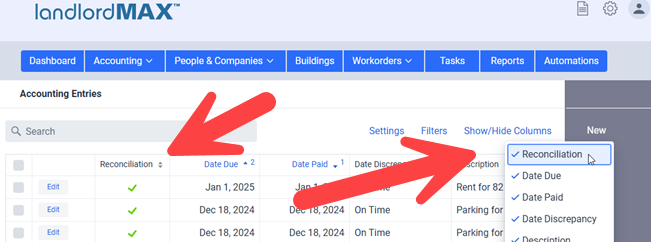
To begin you’ll find a new column is available in the accounting entries table for you to set the reconciliation status. All existing accounting entries will be marked as unreconciled, but if you prefer you can change this to reconciled by checking the select all checkbox at the top of the table and then marking them all the entries as reconciled. Whichever status you decide to start with from that point any new entries will be created as unreconciled until you reconcile them.
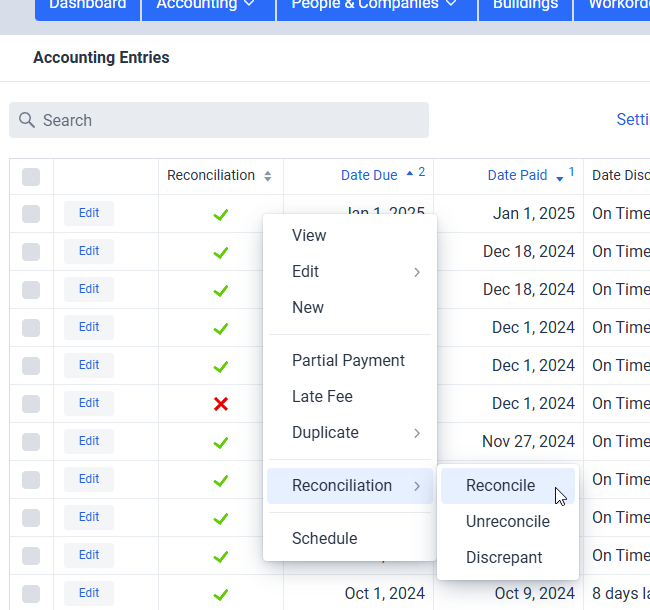
You can reconcile entries in multiple ways, from selecting the entries in the table and right clicking on the status you want (as shown above) all the way to using the right action menu in the table.
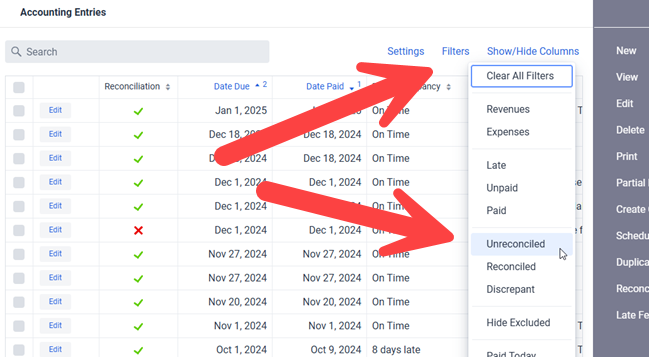
The entries can also be sorted by reconciled which can be very helpful if you want to say just deal with unreconciled entries, possibly discrepant entries, and so on. You can also use the reconciliation filters in combination with other filters as well as the search functionality. Please note that if you change an entry’s status from say unreconciled to reconciled when you have the unreconciled filter on that it will stay on the screen until you refresh it. This is intentional so that entries you change don’t just disappear underneath you, that is they are filtered out.
We’ve also added about 25 new reports in the software, all related to bank reconciliation. These include the ability to run reports by status, for accounts, for buildings, by building, and so on.
That all being said the best way to manage recurring rents, expenses, and so on is through the Scheduled Accounting Entries as they not only save you a ton of time and data entry, but they also give you a lot more power. For example if you were to try to import a bank statement it would be missing a ton of data that makes your life many times easier later. For example a bank statement doesn’t classify a transaction as a rent. It also doesn’t tell you if the rent is early, on time, late, and so on. But more importantly it doesn’t specify for which building, tenant, and so on the rent is for. This can be even more challenging if transactions are combined such as cash payments. Using the Scheduled Accounting Entries allow you to add all this extra information very quickly with minimal effort, just a single click in most cases, which is then all available at your fingertips later. You can find more details on how Scheduled Entries work by clicking here.
Automations are a feature that have been in LandlordMax for some time however with the Cloud Edition we’ve really expanded what you can do with them. You can now automate the running of any report for a tenant or for landlord in a single step. That is to say for example you can run the Tenant Statement for all your tenants in one step. If you’re a property management company instead of an individual investor you can also run the same reports for all your clients (the landlords in your database) in one step by running for example the P&L reports for all landlords. And of course this also includes any custom reports you create for your tenants and landlords.
Please note that all the steps below are shown in the above video. They are provided below for people who prefer reading rather than watching videos.
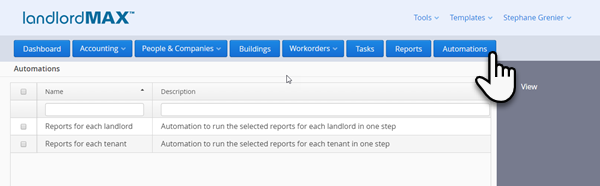
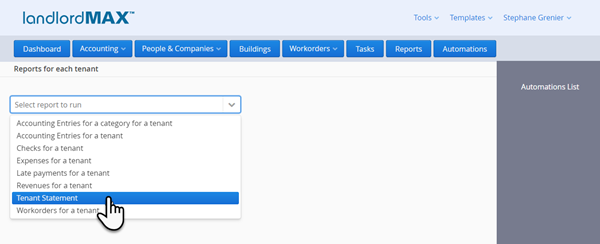
The first step is to go to the Automations section of the software by clicking the Automations button in the main menu as shown above. Once there you will need to select which type of Automation you want to run, whether it’s to run the same reports for every tenant or the same reports for every landlord.
In the above screenshot we’ve gone to the Automations for the tenant reports and have selected to run Tenant Statement for every tenant.
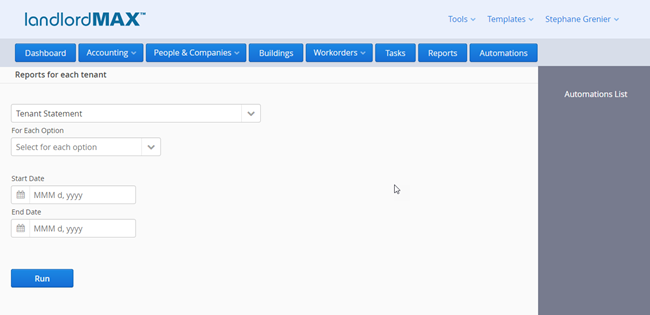
Once you’ve selected a report to run you will then be presented with the report details. For the Tenant Statement this means the Start Date and End Date of the Tenant Statement report. Each report will be different and include whatever the report requires, including your custom reports.
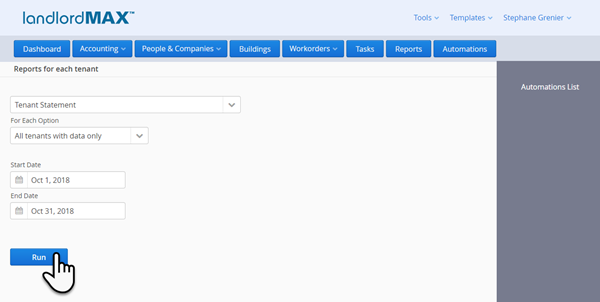
You will then have to select the “For Each Option” for the report, that is which tenants (or landlords) you want to run the report for. For tenants you currently have three options: All tenants with data only, Current tenants, and Current tenants with data only. We generally recommend using the All tenants with data only option as this will run the reports for all tenants that have data (exactly as it states). We generally recommend against using the current tenants option other than in certain exceptional cases because for example if you run a rent roll report for next month and you have a new tenant moving in next month then that is not yet a current tenant and will not appear in the rent roll report where you probably expect them to appear. Therefore generally we recommend using the All tenants (or landlords) with data only option other than the few exceptions where the other options are necessary.
Once you’ve setup everything you can just click on the Run button to run the report for every tenants or landlord as defined by your settings. The system will then present you with a PDF to print, where each report will be separated in the final printouts. It’s as simple as that! In our example we’ve basically just run the Tenant Statement for all our tenants in a few seconds but we could’ve done this for any report for tenants or landlords.
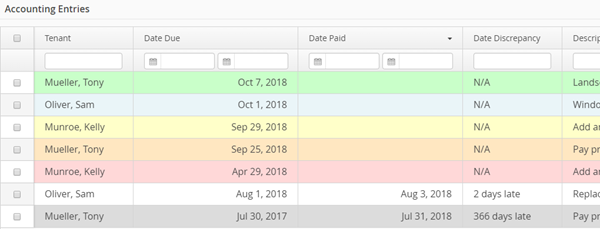
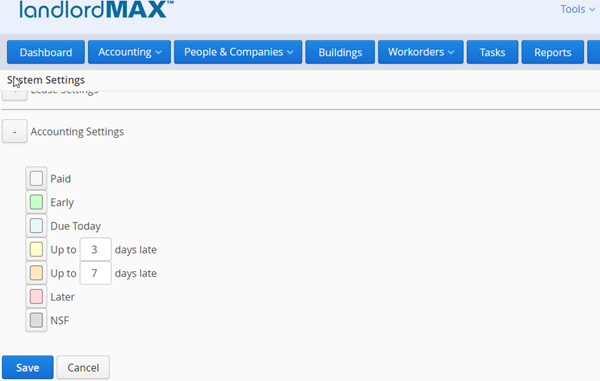
We’re very pleased to announce a new features in LandlordMax called the Accounting Color Codes. LandlordMax now provides you with 7 different color codes to help you with your Accounting Entries. The Color Codes help you determine whether an entry is upcoming and due in the future, if it’s due today, if it’s late, and by how late it is, and so on.
The colors can all be adjusted and set according to your preferences but by default they are green, blue, yellow, orange, red, white, and gray. Green means an Accounting Entry hasn’t yet been paid but is also not yet due. In other words it’s an upcoming transaction that you should be aware of. Blue means that it’s due today. Yellow, orange, and red all mean that the Accounting Entry is late but they signify the lateness of the entry. That is to say yellow means it’s a bit late but still within reasons. Orange means it’s getting late and if it’s a rent payment then you’ve probably already given your tenant a warning. Red means it’s clearly overdue and most likely additional actions need to be taken. By default yellow means up to 3 days late, orange up to 7 days late, and red is more than 7 days late. You can change these settings as shown below to be as many days as you prefer.
In addition to lateness there are two additional color codes which by default are white and grey. White means that an Accounting Entry has been paid (that is it has both a Date Due and Date Paid value entered) and therefore the transaction is completed. Gray on the other hand means the transaction was NSF, such as when a check bounces, and as such the entry is also closed but the funds haven’t been paid nor will they ever be paid for that Accounting Entry.
Again all the colors can be adjusted to your liking by going to the System Settings section of the software and editing the values for the colors, in addition to editing the number of days for the lateness levels.
The video tutorial above shows how these are displayed in the software as well as how to get to the System Settings and adjust them to your personal preference. Basically everything covered here but in video format.
To help you get the most power and value from LandlordMax the above video tutorial shows you many of the capabilities of the tables within the software.
For example did you know that you can select which columns are displayed in the tables? Did you know you can change the column order as well as the sorting order of each column? Did you know you can change the widths of each column? Did you know that you can search for any value in any column in the tables?
Did you also you also know that your table settings are saved so that the next time you come back to the software the tables you customized are shown exactly the way you left them?
The video tutorial goes into this and more details about how to use tables and we’re sure you’re going to learn something new about the software. You can do quite a lot with the tables in LandlordMax, quite a lot more than most people realize, hence why we created this video tutorial.
As a final note did you also know that you can edit entries directly in the tables by doubleclicking on the row you want to edit. You don’t have to go into the entry to edit it, you can now just edit the entry directly in the table.
Many real estate investors unfortunately forget to plan for unplanned maintenance expenses, sometimes also referred to as hidden maintenance expenses. As a general rule of thumb you should budget 1% of the value of the rental per year for maintenance, meaning that for every $100,000 you should be budgetting $1,000 in maintenance costs per year for your rental. Some years there may be no maintenance costs and other years you may have to replace a roof. Over time though the general rule of thumb is that if you budget 1% of the value of the rental per year it should cover most of your real estate rental maintenance expenses. If however you have a fixer upper, an older building, etc. then you will most likely need to use a higher percentage.
With that in mind below is a list of the maintenance costs for rental properties that are too often forgotten or neglected because they aren’t very frequent. In no particular order they are:
Roof
For the average real estate investor this is probably the most expensive and easiest to forget because both infrequent and mostly out of sight until something bad happens such as a leak. Most roofs last between 15-20 years and cost about $8000 to replace depending where the property is located. When purchasing a property it’s usually inspected but after that it’s often forgotten for years therefore it’s important to keep track of around when the roof will need to be replaced.
It’s important to regularly check your roof, even if it’s a new roof. It can be for something as the caulking that’s dried out and cracked leaving water get in to roof tiles that have become damage due to animals and so on. Often these are out of sight and as such don’t get noticed until the problem is much worse then it would be if you regularly inspected your roofs. For example a very small leak from dried caulking that could be very easily repaired by replacing the caulking if found early enough could end up with all kinds of water damages which then need extensive repairs. The challenging part is that some tenants won’t notice things like a water leak, or maybe they just don’t care, but either way it can exacerbate the problem which is why it’s much important to regularly inspect the roofs of your rentals.
Windows
Similar to roofs windows need to replaced every 15-25 years. If you pay for the utilities you’ll probably also want to get more efficient windows to reduce your heating and cooling costs. It can make a surprising the cost difference it makes over time. Windows unfortunately can cost a decent amount but thankfully you don’t always need to replace them all at once, sometimes you can replace them in stages. That being said you’ll probably get a better deal the more windows you replace at the same time.
Windows are also another item which you should inspect regularly, at least once a year. You should look for things such as leaks, condensation, and so on. Even simple things such as the caulking around a window can cause a lot of damage if it starts to dry and crack and let water in. If that happens you may have to not only replace the window but also the walls and any other damage the water has caused. An ounce of preventation here again, just like with roofs, is worth a pound of cure.
Furnace
Again similar to your roof and windows, furnaces have to replace every 15-20 years. Thankfully though the cost is generally lower. You can extend the life of your furnace by doing yearly maintenance on it, and often the costs of the yearly maintenance will end up saving you money over the long term because it can significantly increase the lifespan of a furnace.
The main problem with furnaces is that they can fail at any time, and if it’s winter outside you may have some legal obligations as to how quickly the furnace has to be repaired which may entail emergency furnace surfaces and/or higher costs, especially if it happens over holidays like Xmas. And even beyond the legal expectations you probably want to repair it sooner than later if it’s winter to avoid pipes in the property freezing and bursting causing even more damage. Therefore not only is it good to do regular maintenance so that you get a sense of when your furnace is near it’s end, but you can also decide to replace it before it fails completely.
Air conditioner
Air conditioners have a slightly lower lifespan and generally last 10-15 years. Much like furnaces they are also less costly to replace than roofs and windows but they still cost a fair amount. Depending on your location there may also be some laws or expectations as to how long you have to repair the air conditioner therefore it’s also important to inspect it on a regular basis.
Fences
Depending on the type of fence you have the lifespan can vary quite a bit. For example most wooden fences will last 10-15 years whereas a chain-link fence can last 15-20 years. In either case you should include replacing your fence in your maintenance budget. On a positive note fence repairs can generally be delayed if need be assuming the fence isn’t completely broken or an immediate danger to anyone. In other words you may have more flexibity as to when you need to repair a fence depending on the damage then with most of the items on this list.
Appliances
Appliances can and do break down, and these days appliances tend to last less long then their did in the past. No longer is it normal to have an appliance last you 15-20 years, most appliances today have much shorter lifespans today. In addition it’s often more cost effective to replace appliances then to repair them. Appliances is one of the few items their durability has gotten worse over time. On a positive notes appliances tend to be replaced separately (unless you’re doing a renovation or upgrade) and therefore the costs can be spread out over time.
Most appliances cost between $500-$2000 depending on the type of appliance combined with the features it comes with. It’s generally recommended to avoid the lowest price appliances as they tend to have short lifespans but at the same time you probably also want to avoid higher end appliances as they generally aren’t worth it for rentals unless you rent luxury or high end units.
To get the best value out of your appliances it’s good to involve your tenants with their care. For example if the rental includes a clothes washer and dryer then make sure they empty the lint trap regularly. You may not be able to be there but you can educate them and put other measures in place. There may also be some legal expectations in your local area as to what the tenant’s responsibility are towards the appliances so be sure to look those up beforehand and preferably inform the tenant so they know what they need to do and what they are responsible for. Don’t assume that the tenant knows what a lint trap is, be prepared to educate them. Both of you will benefit from this.
Deck
Although this generally does not apply to apartments for most single residence homes, duplexes, and so on, it’s fairly common for properties to have decks. Decks can range from very simple little structures to large structures that take most of the yard, therefore deck costs are highly dependent on the property, type of deck (wood, etc.), and size of the deck. The lifespan of decks varies a lot based on the types of materials used to build the deck, but your average simple deck made of pressure treated wood should last 10-15 years.
Many people try to save money building their own decks since they seem simpler but if you do this make sure you’re aware of all the rules and regulations for decks because if something ever happens and your deck is not up to code you could be legally liable if the tenant or other persons are injured due to the deck not being up to code. Many areas also have different rules based on whether or not the deck is attached to your house, or even how it’s attached, so it’s important to inform yourself yourself beforehand if you plan on building the deck yourself.
Pavement
Most properties will have some kind of pavement, be it a sidewalk, a driveway, stairs leading up to the front door, etc. Pavement generally lasts 10-20 years depending on the quality and how heavily it’s used. The costs vary wildly depending on the amount of pavement your property has. For example a simple one lane asphaly driveway will cost a lot less than a two lane stone paved driveway with all the trimings. Weather conditions greatly affect pavement in that colder areas where water freezes in the winter often cause the pavement to prematurely crack so it’s important to check for cracks and damage on a regular basis and fix them so that they don’t expand, reducing the lifespan of your pavement.
Foundation
House foundations are meant to last years and years but it’s important to regularly inspect them, at least once a year. You want to look for cracks, not just any kind of cracks but specific types of cracks. Cracks are expected and are part of the normal wear and tear due to the forces on the structure. however extensive cracks, cracks that let water , and cracks that in the form of steps should be re-inspected by a professional right away to avoid major issues. Left un-treated foundation issues have the potential to lead to much bigger issues later, costing a lot more. Foundations are one of the few things that can completely destroy a house.
The hard part with foundations is that if there is an issue it can be very costly and most likely it will exceed your 1% budget, so it’s important to get a good inspection before you purchase the property. That being said it’s also why it’s so important to regularly inspect. Bad cracks can not only lead to water causing more water damage but a big enough crack can also let in bugs causing additional expenses. But more importantly a bad crack can weaken the foundation which in turns amplifies the problem and costs. Therefore it’s important to regularly inspect the foundations of your properties and handle foundation issues as soon as possible.
Hot water
Today we see a lot of both hot water tanks and on-demand hot water, and both seem to last anywhere from 10-15 years (on-demand hot water tankless systems are still relatively new so their lifespans aren’t fully known yet). There is however a trend for companies to try to rent out these units to you where they will do the maintenance as part of the rental process. In either case it is important to budget the cost monthly rental fee or the maintenance costs if you own the units.
Plumbing
Although most people don’t worry about their plumbing until something happens the pipes in your house are not designed to last forever, they will eventually wear out. Thankfully in most cases you don’t have to replace all the plumbing in one step unless you’re doing a major renovation, however if your tenant reports a leaky pipe it is a very good idea to fix it as soon as possible to avoid much bigger damages. It may just be a slow leak but you never know, and if something worse happens it could be very costly. Many insurance companies will not cover damages due to a leak that was left unrepaired meaning that if the slow leak becomes a bigger problem you maay not be covered for the damages incurred due to negligence by leaving the leak get worse. There may also be some legal liabilities depending on your local area and the nature of the leak in regards to damages to the tenant’s property if they notified you and you ignored a leaking pipe. Either way it’s a good idea to address leaky pipes and so on right away, water damages tend to escalate in scope and price very quickly.
With plumbing you also have simpler and smaller maintenance costs such as replacing faucets and so on but they are generally fairly affordable in comparison to the other items on this list. In addition they tend to last 10-15 years depending on their quality and usage.
Weather
Yes this is NOT a maintenance issue but you should expect a certain amount of weather damage over time. Insurance may cover part of the damages but they may not, and if they do most likely you will have to cover the deductible (and your insurance payments may increase). Some areas experience a lot more active weather than others, or have much harsher climates, so depending on where your rental properties are located you may need to adjust your budget accordingly.
In addition to having a duty to provide your tenant’s with a pest free environment, it also helps to keep your tenant turnover rate lower, to keep your maintenance costs down due to less damages, and it helps to keep the property values up, all of which are good for you.
1. Educate your tenants
The simplest and most effective thing you can do is educate your tenants about pests, what signs to look out for, when to call for help, and so on. We often assume that most people are familiar with signs of pests and what to do but this is far from true, many tenants have no experience with pests. In some cases they may not even know what signs to look out for. Educating your tenants can be as simple as providing them an educational pamphlet when they move in. To get the best results you should also include what warnings signs they need to be on the lookout for and when they should contact you.
Part of the educate should also focus on prevention, such as letting them know that keeping doors and windows without screens open is an invitation for pests to come in. You can also increase their motivation to work with you in preventing pests by reminding them that they could also face some financial responsibilities if they are negligent. With that in mind explain to them the importance of taking out the garbage, not leaving food out for extended periods, of leaving dirty dishes in the sink forever, and other general cleanliness expectations from them as tenants.
2. Regularly inspect your properties
This can be as simple as you doing a walkthrough of the rental to look for any signs of pests but can be as extensive as having a pest control service come in on a regular schedule to do a look over of the property with the tenant. You can alternatively send your tenants scheduled reminder notices or emails to remind them that they should do their own pest inspections themselves. If a tenant has a cleanliness problem then it’s important to follow-up and verify that the situation is being resolved.
When doing a walkthrough looking for pests you should also try to find potential ways they can come into the property. Look for holes, even small holes, in the outside walls, in the cement, by the windows, etc. Look for holes in windows screens and doors. And often overlooked item is the space under the door, it can sometimes be big enough for a small roddent to come in, nevermind bugs. Make sure that the exhaust pipes for the laundry, furnace, etc. all have screens in front of them to prevent small animals from going in. If at all possible look at the chimney, it’s very easy for animals to come in and get into your attic. In fact it’s a very good idea to also go into the attic to look for critters, plus it gives you a chance to inspect the property overall. The key is that an ounce of prevention is worth a pound of cure.
Disclaimer:This is a blog and the contents of this blog are for informational purposes only. No content should be construed
as financial, business, personal, or any other type of advice. Commenters, advertisers and linked sites are entirely responsible
for their own content and do not represent the views of myself. All decisions involve risks and results are not guaranteed.
Always do your own research, due diligence, and consult your own professional advisors before making any decision.
This blog (including LandlordMax Software Inc.) assumes no liability with regard to results based on use of information
from this blog. If this blog contains any errors, misrepresentations, or omissions, please contact us or
leave a comment to have the content corrected.